 Periglacial Field Note • Adventdalen & Tuktoyaktuk
Why Frozen Ground Organises Itself Into Hexagons and Rings
When winter temperatures plunge rapidly below −25°C, permafrost contracts and splits with a rifle-shot crack, opening narrow vertical fissures five to fifteen meters apart. During spring snowmelt, liquid water trickles into these open thermal contraction cracks and freezes immediately into a vertical vein of clear ice. When summer warms the active layer above, the expanding soil cannot close the ice-filled crack; instead, the adjacent sediment buckles upward into raised rims.
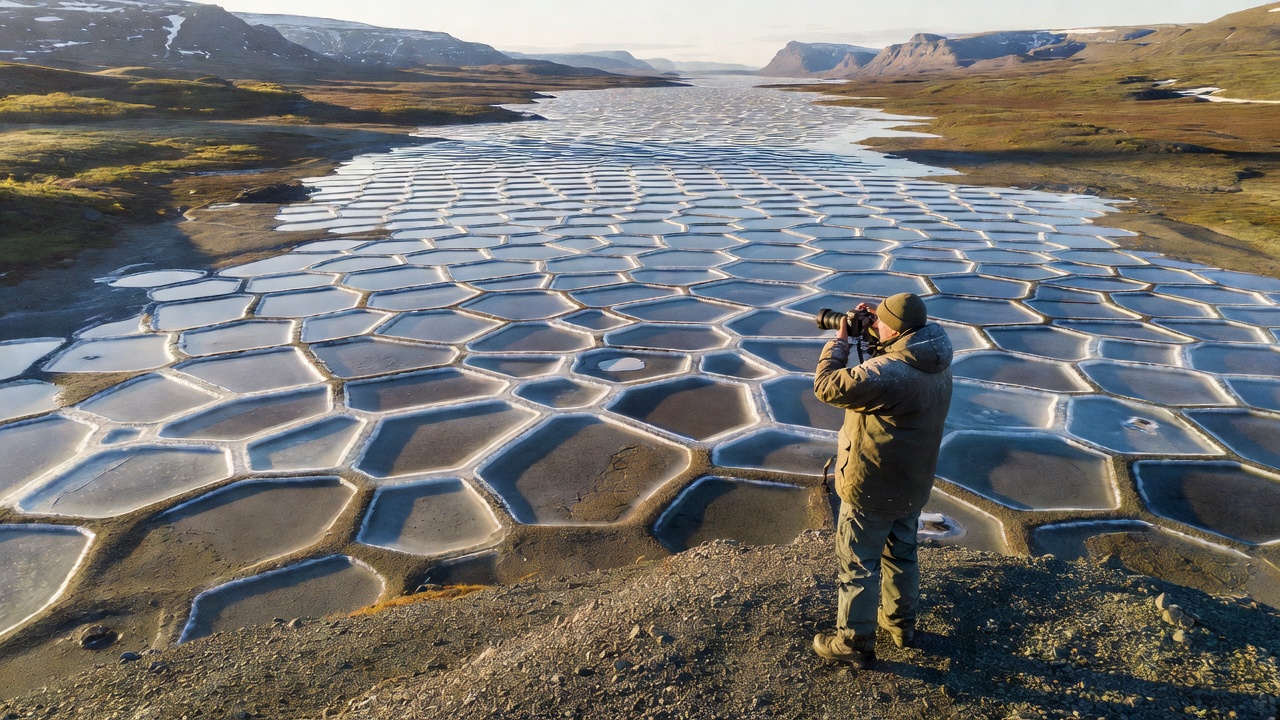
Over hundreds of annual cycles, these ice wedges grow up to several meters wide, organizing valley floors into vast honeycombs of low-center or high-center polygons. As a photographer, standing inside a polygon trough yields only a confusing foreground of tussocks. Climb twenty meters up an adjacent talus slope or river terrace: from even a modest oblique angle, the polygonal troughs catch sky reflection or lingering snow drifts, drawing a crisp network across your frame.