Habitat Respect • Energetic Ethics

Photograph Without Intruding

Every Arctic shoreline, polynya, and snow-free ridge is a scarce survival corridor. An image made by flushing a resting bird or forcing a seal off the ice is a field failure, regardless of its sharpness.

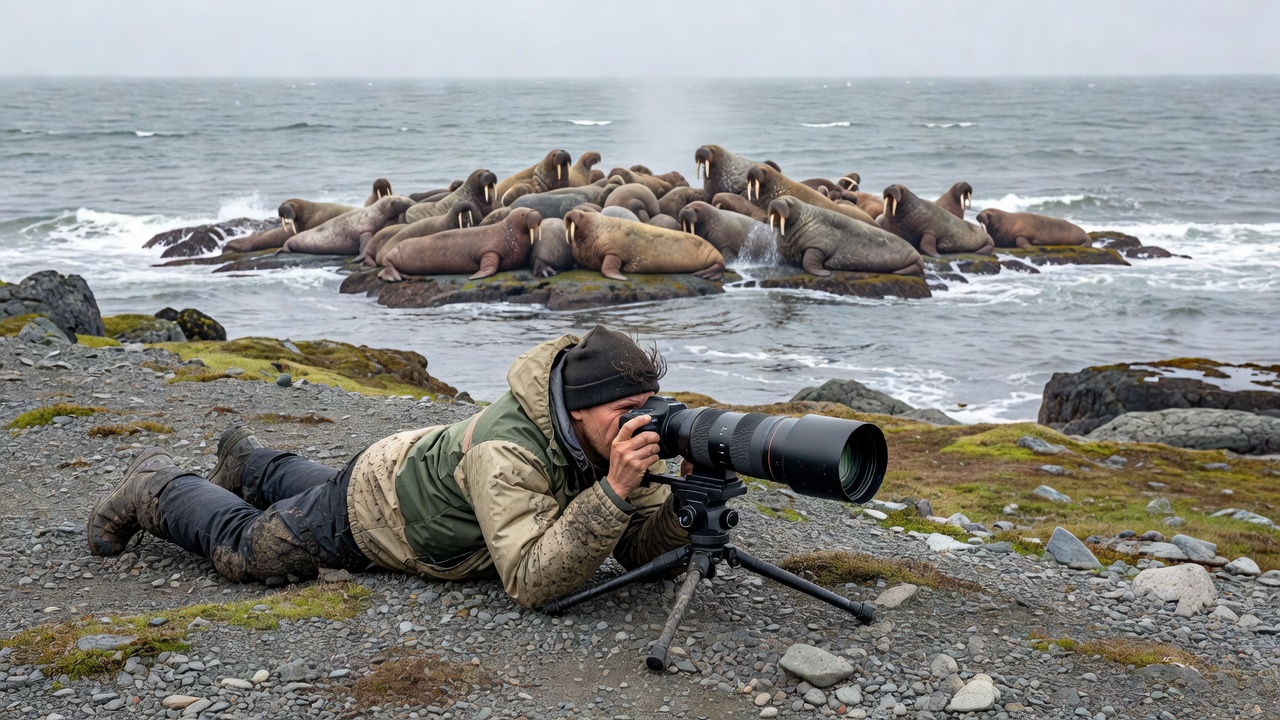
Photographer lying prone on a distant gravel ridge using a telephoto lens to observe a coastal haul-out without disturbing the animals Respectful Distance • Prins Karls Forland

Why Environmental Context Outweighs Tight Wildlife Portraits

Along low gravel spits in Svalbard, Franz Josef Land, and Foxe Basin, Atlantic and Pacific walruses (Odobenus rosmarus) haul out in tightly packed groups to rest and conserve body heat between benthic foraging dives for bivalves. Approaching a haul-out upright across an open beach triggers immediate head-raising, vocalization, and—in the worst cases—a panic stampede into the surf that can crush calves and exhaust adult energy reserves.

When our field team documented a raised beach lagoon on Prins Karls Forland, we halted 350 meters downwind behind an ancient driftwood-strewn storm berm. Using a 400mm lens on a low ground pod, we framed the resting herd as a warm terracotta cluster occupying less than ten percent of the frame, dwarfed by stranded ice blocks and the mist-shrouded jagged peaks of the Forlandaksla range. The photograph explained where and how the animals inhabit the littoral zone—and when we packed up an hour later, not a single animal had lifted its head on our account.

Understanding Energetic Budgets in the Cold

To understand why distance regulations in regions like Svalbard, Greenland National Park, and Nunavut are so strict, photographers must think in terms of winter and spring bioenergetics:

Botanical Fragility & Ground Impact Protocols

Arctic vegetation grows inside an active soil layer only centimetres thick above impermeable permafrost. Because soil temperatures hover near freezing even in July, microbial decomposition and root regeneration occur extraordinarily slowly.

Habitat Zone Primary Ecological Vulnerability Early Stress Signal to Watch For Required Photographer Action
Fast-Ice Edge & Polynyas Resting seals, foraging eiders, and hunting polar bears Seal raises head repeatedly ("sky-watching") or shifts flippers toward water Freeze movement immediately, crouch to break human silhouette, and retreat slowly along your incoming track
Basalt & Dolerite Bird Cliffs High-density nesting ledges and nutrient-rich talus slopes below Alarm calling, synchronized head turning, or birds taking flight in rapid waves Stay on the valley floor or coastal beach; never peer over cliff rims; observe strict zero-drone zones
Wet Moss Tundra & Fens Waterlogged bryophyte carpets and ground-nesting waders (dunlin, phalaropes) Deep boot imprints filling with meltwater; adult wader performing "broken-wing" distraction display Detour onto bare gravel moraines, dry bedrock, or snow patches; watch every step to avoid cryptic ground nests
Polar Bear Territory Mutual safety of bears and humans across all Arctic marine coasts Any sighting of tracks, scat, or a bear at any distance through binoculars Never approach for photography; retreat immediately to shelter or vessel alongside an armed, certified polar guide
Absolute Refusal of Baiting, Call Playback & Drones Near Wildlife

Spryl Arctic Mosac strictly condemns feeding Arctic foxes, using acoustic bird calls, throwing stones into water for splash shots, or operating unmanned aerial vehicles near wildlife or inside protected Arctic reserves. In jurisdictions such as Svalbard (since the 2025/2026 environmental regulation updates), operating drones within 500 meters of bird cliffs and haul-outs or disturbing polar wildlife carries strict legal prosecution.