Why Lateral Sun Movement Changes How You Scout a Ridge
In temperate mountains, photographers pick a tripod spot and wait for the sun to drop vertically toward the horizon. In the high Arctic during March, April, September, or the June midnight sun, solar altitude barely changes over three hours while its azimuth sweeps thirty to forty-five degrees laterally across the compass.
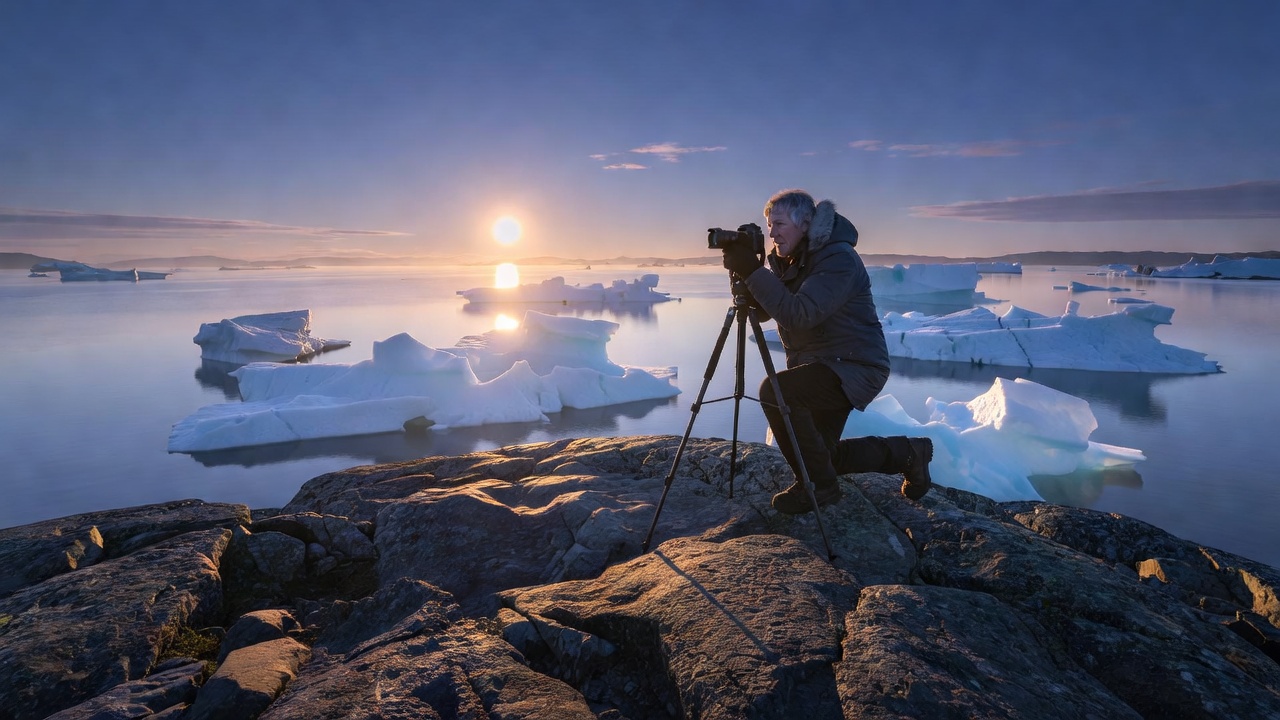
That horizontal sweep means shadows do not merely lengthen—they pivot around every pressure ridge, erratic boulder, and mountain spur like the hand of a sundial. When scouting a coastal terrace in Disko Bay or Varangerfjord, trace the compass bearing of linear snow flutes and glacier valleys first. Wait until the sun's azimuth crosses perpendicular (75° to 105° off-axis) to the dominant surface ridges; at that exact lateral window, two-centimeter frost ripples suddenly step forward in three-dimensional relief.
The Five Seasonal Regimes of Arctic Light
Planning fieldwork or interpreting archival photographs requires knowing which solar phase governs the latitude and month:
- Polar Night & Nautical Twilight (November–January at 78°N): Even when the solar disc remains more than 6° below the southern horizon at solar noon, clear days produce a four-hour band of amber-ochre glow along the southern horizon while full moonlight and green 557.7 nm atomic oxygen aurora emissions illuminate snow-covered peaks with surprising detail.
- Return of Grazing Twilight (February–Early March): The sun hovers between −6° (civil twilight) and +3° elevation. The Belt of Venus—pink backscattered light floating above the dark slate wedge of Earth's rising shadow—lingers for hours, casting shadowless pastel gradients across sea ice.
- Equinox Lateral Light (Late March–April & September–October): High albedo from unbroken snow cover bounces skylight into shadow faces, reducing contrast ratios so both sunlit peaks and shaded fjord walls hold detail within a single sensor exposure.
- Midnight Sun & Polar Day (May–August): Because the sun dips lowest across the northern horizon around local solar midnight, north-facing glacier faces and coastal cliffs—which remain in shadow all year at lower latitudes—receive warm directional gold light between 23:00 and 02:30.
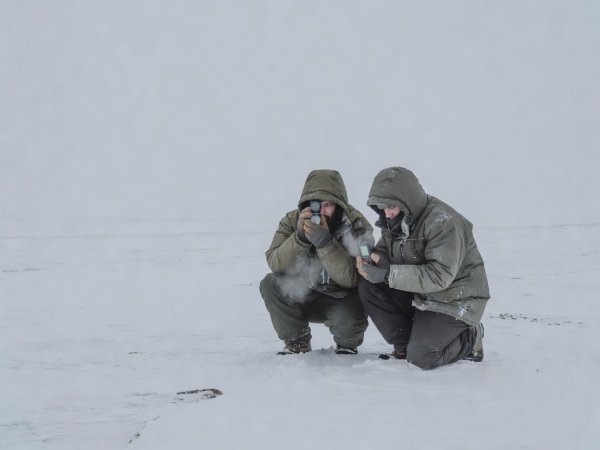
- Overcast Stratus & Whiteout Diffusion: When low arctic stratus cloud merges visually with snow-covered terrain, multiple reflections between cloud droplets and high-albedo snow erase horizon lines and surface shadows entirely.
Atmospheric Optics: Halos, Parhelia, and Sky Maps
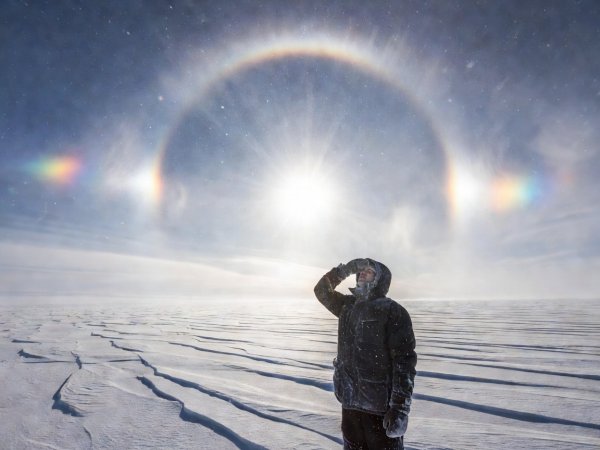
Cold polar air holds very little moisture, often precipitating suspended hexagonal ice plates and columns known as diamond dust under cloudless skies. When low sunlight passes through these oriented crystals, it refracts at 22° to form circular halos, bright parhelia (sundogs) flanking the sun at the same elevation, upper tangent arcs, and vertical sun pillars.
When framing a 22° halo, note that its angular radius requires at least a 20mm or 24mm full-frame equivalent lens to capture both sundogs and the upper arc together with a grounded landscape horizon. Avoid stopping down to f/16 or f/22 directly into the solar disc, which introduces internal lens flare polygons that obscure subtle natural refraction arcs; instead, hide the solar core behind a rock cairn, ridge crest, or stranded iceberg sail.
Whiteout Disorientation & UV Keratitis
In true acoustic and visual whiteout, diffuse light reflects equally from all directions, causing immediate loss of depth perception—you can step off a three-meter snow cornice without seeing the edge. Record waypoints continuously on a dedicated handheld GPS or compass bearing before visibility drops, and always wear Category 3 or 4 wrap-around glacier glasses; fresh snow reflects up to 85% of UV radiation from below your hat brim.
 Solar Elevation Study • Disko Bay, 69°N